


News Center
Recommending Products
Contact: Mr. Jin
Tel: 13901575780
0512-52428686
Contact: Mr. Zha
Tel: 13913639797
0512-52422071
Address: No. 59, Huyi Road, Liantang, Shanghu Town, Changshu City, Jiangsu Province.
What is the service life of the slitting round knife reflected in
1、 Cutting quality degradation (the most direct way to determine the end of life)Sources:www.cssjlgj.com | PublishDate:2026.06.15
1. The burrs on the incision become more variable and larger
The initial section is smooth and flat; After the tool wears out, burrs, flanging, and drawing appear on the upper and lower edges of the material, especially when cutting thin films, paper, metal foil, and tape. Excessive burrs indicate that the cutting edge has become blunt.
2. Trimming, fuzzing, chipping, and drawing
Non woven fabrics, foam, copper aluminum foil, composite materials, blunt knives will pull the materials instead of cutting them, resulting in fluff and tearing at the cross-section; Hard materials may also experience intermittent edge breakage.
3. Decreased dimensional accuracy
After wear, the clearance between the cutting edge deviates, the cutting width tolerance increases, and the width of the same batch is inconsistent; During high-speed cutting, the blade swing increases and the width fluctuation becomes more severe.
4. Indentation, wrinkling, and scratching of the substrate
The circular blade edge is worn and passivated, requiring increased material pressure to cut. If the pressure is too high, it will thin and wrinkle the film/aluminum foil; Fine debris on the blade surface can also longitudinally scratch the surface of the coil material.
2、 Changes in equipment operating conditions
1. The cutting resistance increases and the motor load increases
The sharp increase in friction force during blunt blade cutting leads to an increase in host current and energy consumption; High speed machines are prone to load alarms and limited acceleration, making it impossible to reach the rated production speed.
2. Increased abnormal noise and vibration
Uneven wear of the cutting edge, local tooth breakage, and periodic vibration during rotary cutting; The tool shaft and tool holder shake, and the bearing loss accelerates synchronously.
3. Accelerated roller loss
To compensate for the dull cutting force, the pressing force of the pressure roller continues to increase, and the wear, indentation, and aging speed of the silicone pressure roller and rubber pressure roller is doubled.
4. Increased risk of knife breakage and explosion
The local small cracks of the hard alloy round knife continue to expand under stress, and it is easy for the whole piece to crack under high-speed rotation; Thin slitting knives are prone to uneven stress and fracture after wear.
3、 Increased consumption of consumables and auxiliary materials
1. Accelerated wear of gasket/bottom blade
Up and down cutting mode: The blunt and hard friction bottom blade with a round blade edge significantly increases the wear rate of the bottom blade and polyurethane pad blade ring, and the frequency of replacement is greatly increased.
2. Increased consumption of lubricating oil and cooling oil
Friction heating increases, requiring an increase in the amount of spray cooling oil, which increases the probability of oil contamination adhering to the product and leads to an increase in defective products.
4、 Output and production efficiency indicators
1. Significant decrease in effective meters
The new knife can stably cut tens of thousands to tens of thousands of meters (depending on the material), and after wear and tear, its production capacity is halved. It frequently stops to adjust and sharpen the knife.
2. Sudden increase in shutdown frequency
Frequent shutdown for grinding, adjusting clearances, and cleaning tool debris; The sorting hours for defective products have increased, resulting in a decrease in overall production rate.
3. The number of grinding cycles approaches the limit
Each round knife has a fixed grindable allowance (such as scrapping after reducing the total thickness by 2-4mm), and each time it grinds, it eats up one layer of substrate. The end of its service life is when the number of grindings is exhausted.
5、 The appearance and physical wear of the cutting tool itself
1. Blade edge arc passivation
The sharp new blade edge is an extremely thin acute angle; After wear and tear, it turns into a rounded corner, and the arc transition is clearly visible to the naked eye/magnifying glass.
2. Microscopic damage to the cutting edge
Minor tooth breakage, scratches, chipping, and corrosion points; Wear is faster when processing materials filled with adhesive, dust, and abrasives.
3. The overall thickness becomes thinner
After multiple rounds of grinding, the thickness of the tool substrate continues to decrease, the rigidity decreases, and high-speed rotation is prone to deformation and jumping. Even if the cutting edge is ground, stable production cannot be achieved.
Comparison of lifespan reference for circular knives made of different materials
High speed steel round knife: cost-effective, suitable for paper, film, and ordinary tape; Medium lifespan, easy to blunt, requiring frequent grinding.
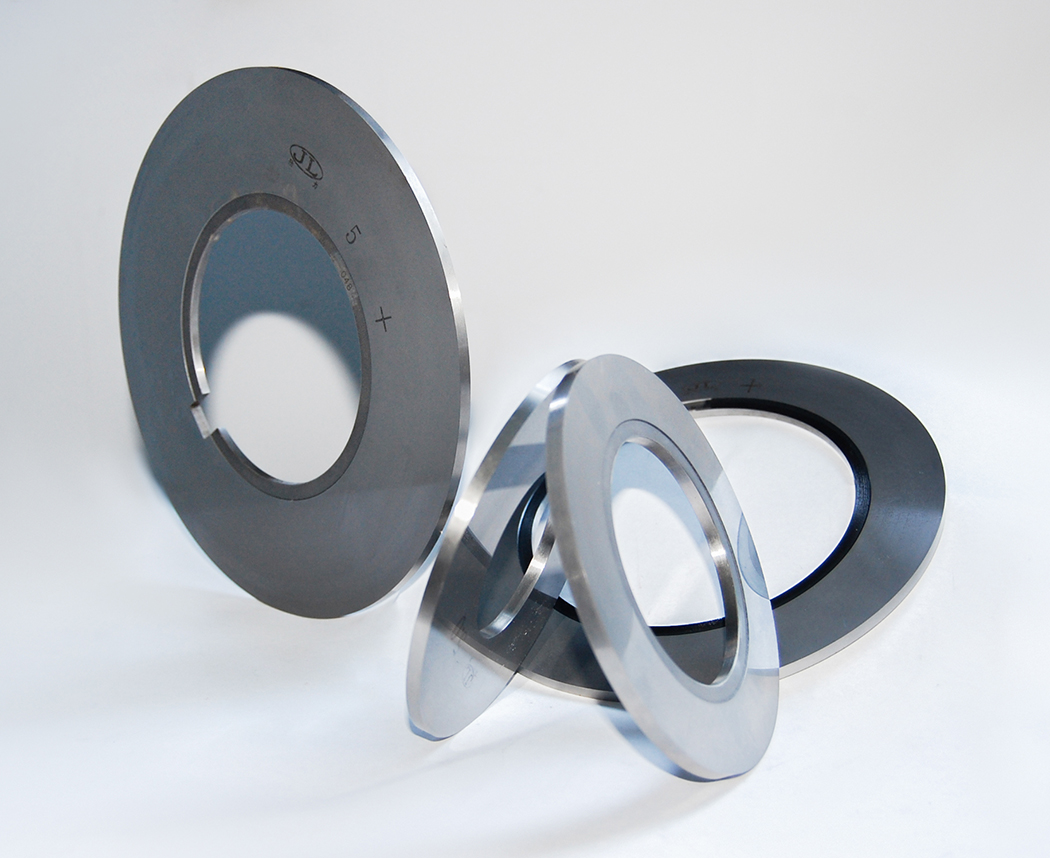
Hard alloy (tungsten steel) round knife: high hardness, wear resistance, copper aluminum foil, glass fiber, thick composite material selection; The lifespan is 3-8 times that of high-speed steel, but it is afraid of impact and breakage.
Ceramic coated/diamond coated round knife: high wear resistance, containing sand, foam, and strong adhesive materials; The longest lifespan and high cost.