


News Center
Recommending Products
Contact: Mr. Jin
Tel: 13901575780
0512-52428686
Contact: Mr. Zha
Tel: 13913639797
0512-52422071
Address: No. 59, Huyi Road, Liantang, Shanghu Town, Changshu City, Jiangsu Province.
What are the commonly used substrates for flat edged circular knives
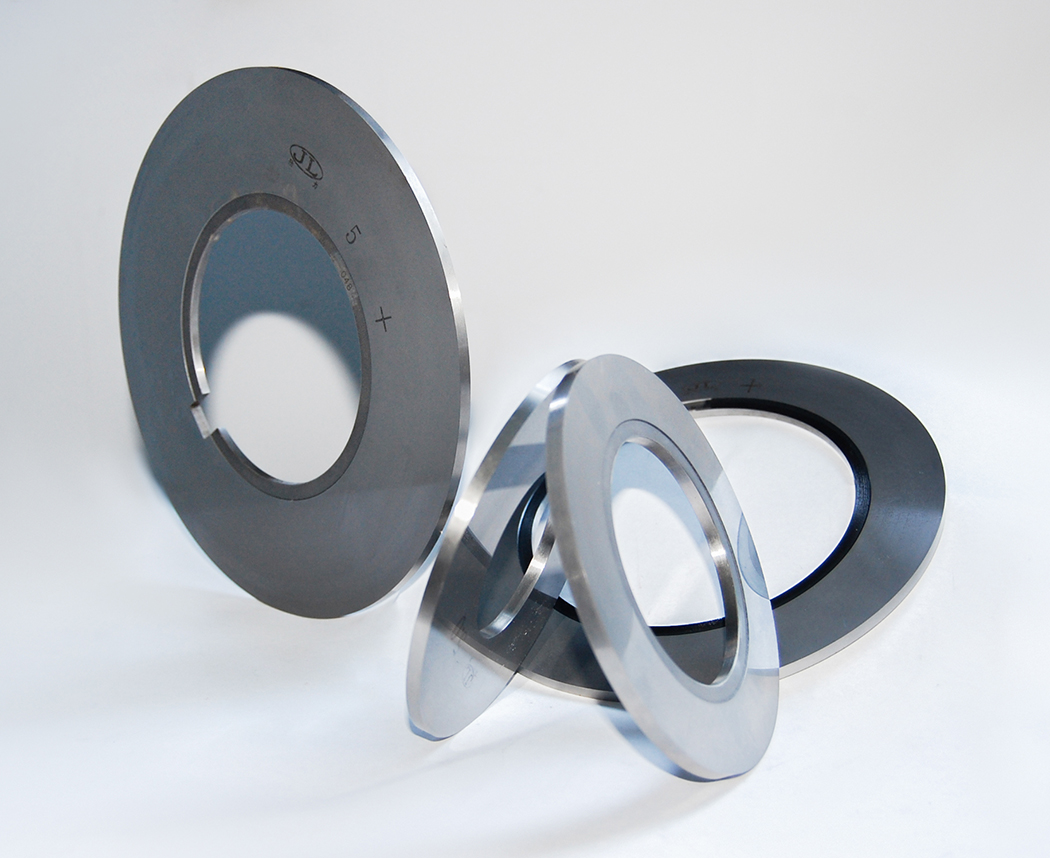
The selection of base materials for flat edge circular knives is based on cutting media, linear velocity, load, accuracy, and anti-corrosion requirements. The mainstream base materials in the industrial field are divided into seven categories: high carbon and high chromium cold work mold steel, high-speed steel (HSS), powder metallurgy high-speed steel, hard alloy (tungsten steel), alloy tool steel, martensitic stainless steel, and spring tool steel. The properties and applicable working conditions of each base material are as follows:Sources:www.cssjlgj.com | PublishDate:2026.09.14
1、 High carbon and high chromium cold work die steel
1. Cr12MoV (National Standard)
Belonging to high carbon high chromium molybdenum vanadium cold work die steel, the hardness can reach HRC58-62 after vacuum quenching and deep cold tempering, with excellent hardenability, controllable heat treatment deformation, uniform distribution of matrix carbides, and a balance between wear resistance and certain toughness. It can be repeatedly ground. Suitable for cutting paper, non-woven fabrics, ordinary films, stickers, rubber, thin plastics and other medium to light loads, it is the mainstream substrate for universal flat mouth circular knives. Shortboard has limited impact toughness and is not suitable for strong impact conditions. In humid environments, surface rust prevention treatment is required.
2. SKD11 (Japanese standard, equivalent to D2/1.2379)
JIS G4404 cold work die steel has a vanadium content higher than Cr12MoV, better wear resistance, good dimensional stability, and a hardness of HRC60-63 after heat treatment. A precision flat edged circular knife suitable for medium wear conditions such as hard plastics, thick cardboard, fiberglass composite materials, and thin aluminum strips, widely used in high-speed slitting machines. The disadvantage is that the impact toughness is relatively weak, and it is prone to slight chipping of the cutting edge under lateral loads, making it difficult to grind and process.
2、 High speed steel HSS
1. W6Mo5Cr4V2 (M2, molybdenum high-speed steel)
The most commonly used general-purpose high-speed steel has a heat treatment hardness of HRC62-66, with red hardness and balanced toughness. It has good grinding processability, and the cutting edge can be ground to a high sharpness. Its vibration resistance is better than that of high chromium mold steel. Suitable for high-speed precision cutting of thin films, aluminum foils, copper foils, synthetic fibers, and thin non-metallic materials, suitable for production lines with slight vibrations during cutting. TiN and TiAlN coatings can be applied to enhance wear resistance and lifespan.
2. W18Cr4V (tungsten based high-speed steel)
Traditional tungsten based high-speed steel has excellent red hardness, wide quenching process window, is not easy to overheat and decarburize, stable structure, and is suitable for medium and high-speed continuous cutting conditions. Commonly used for flat edged circular knives with high temperature stability requirements, suitable for cutting hot melt films and thick paper materials; Compared to molybdenum based high-speed steel, its toughness is slightly lower.
3. SKH-51, M35, M42 (including cobalt high-speed steel)
Adding cobalt element significantly improves the red hardness and high-temperature wear resistance, with a hardness of HRC64-68, and strong anti softening ability of the cutting edge under high-speed continuous cutting. Used for precision cutting with high linear speed and high friction heat generation, such as PET film, multi-layer composite film, and metal foil; The material cost is higher than that of ordinary M2 high-speed steel.
3、 Powder metallurgy high-speed steel (PM high-speed steel, such as HAP40, PM23)
Prepared using powder metallurgy technology, the carbide structure is fine and uniform, without coarse carbide segregation, while achieving high hardness, high wear resistance, and good toughness. The heat treatment deformation is minimal, and the size consistency is excellent, which can withstand high load, high speed, and strong wear conditions. Suitable for precision flat mouth circular knives, such as lithium battery separators, optical films, high-strength composite materials, and thin stainless steel strip slitting; The substrate has a high cost and is often used for complete cutting equipment.
4、 Hard alloy (tungsten steel, WC Co)
A powder metallurgy hard alloy with tungsten carbide as the matrix and metallic cobalt as the bonding phase, with a hardness of HRA89-92.5, far superior wear resistance to various tool steels, good thermal stability, long-term high precision of the cutting edge, and almost no plastic deformation. Suitable for long-term continuous cutting of high abrasion materials, metal strips, fiberglass, and carbon fiber composite materials, it is a high-precision and long-life flat edge circular blade substrate. Limitations: High brittleness, poor impact resistance, easy breakage of the blade under impact, high processing cost, generally used for thin flat edged circular knives made of solid hard alloys or circular knives with embedded blade structures. Commonly used grades such as K10, K20, etc., the higher the cobalt content, the better the toughness, and the corresponding decrease in wear resistance.
5、 Low alloy tool steel (9CrSi, CrWMn)
9CrSi is a silicon chromium alloy tool steel with good quenching hardness, better toughness than high chromium steel, less heat treatment deformation, lower cost, and a hardness of HRC55-60. A flat edged round knife commonly used for cutting low-speed, light load, ordinary paper, leather, and thin rubber; The wear resistance is average, and the blade edge decays quickly under high-speed or abrasive material conditions, making it an economical substrate.
6、 Martensitic stainless steel (440C/9Cr18)
High chromium martensitic stainless steel, with a hardness of HRC57-61 after quenching, has excellent corrosion resistance and can meet the requirements of food, medicine, clean workshops, and high humidity environments. It is easy to clean. Used for cutting flat edged circular knives for food packaging films, medical dressings, and wet materials; The wear resistance is weaker than Cr12MoV and SKD11, making it unsuitable for strongly abrasive materials.
7、 Spring tool steel (65Mn)
Carbon spring steel, low cost, good toughness, HRC52-58 after heat treatment. Only used for low-speed, light load, low precision cutting scenarios, such as simple cutting of ordinary fabrics and thin cardboard; Low hardness, poor wear resistance, easy to roll cutting edge, generally not used for high-speed precision slitting flat edge circular knives.